

Potassium permanganate content selection:
The content directly determines the product's purification capacity and reaction rate. Higher content means a larger total amount of pollutants can be treated, and the efficiency is generally higher.
How to choose?
Low-concentration environments (e.g., general indoor air purification): Products with a content of 3%-5% can be selected.
Medium-to-high concentration environments (e.g., ethylene removal in cold storage, industrial waste gas treatment): It is recommended to choose products with a content of 5% or higher to ensure long-term effectiveness and stability.
Selection of Strength and Abrasion Resistance:
Products with low strength are prone to breakage and pulverization during filling and use. The resulting fine powder can clog equipment pipelines, increase system pressure drop, and even damage downstream fans or precision instruments.
How to choose?
It is usually expressed as a percentage; the lower the abrasion rate, the better.
Particle Size and Uniformity Selection:
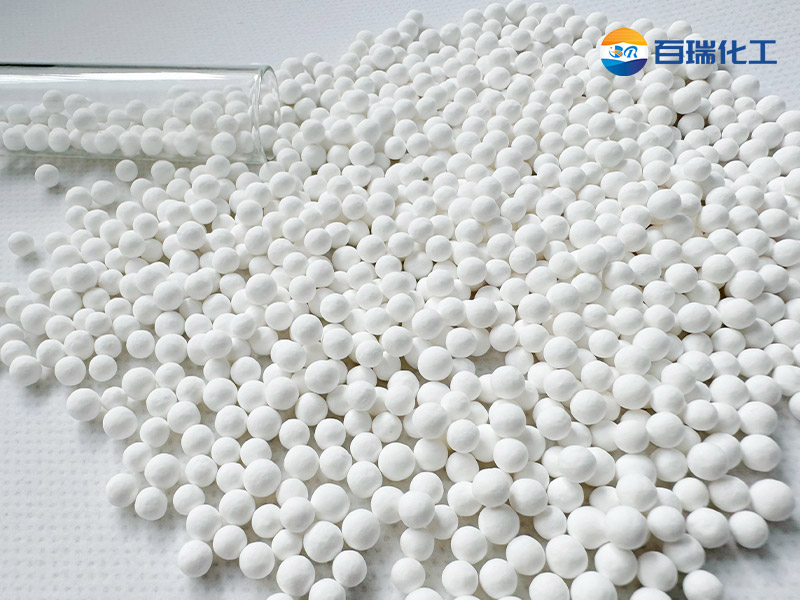
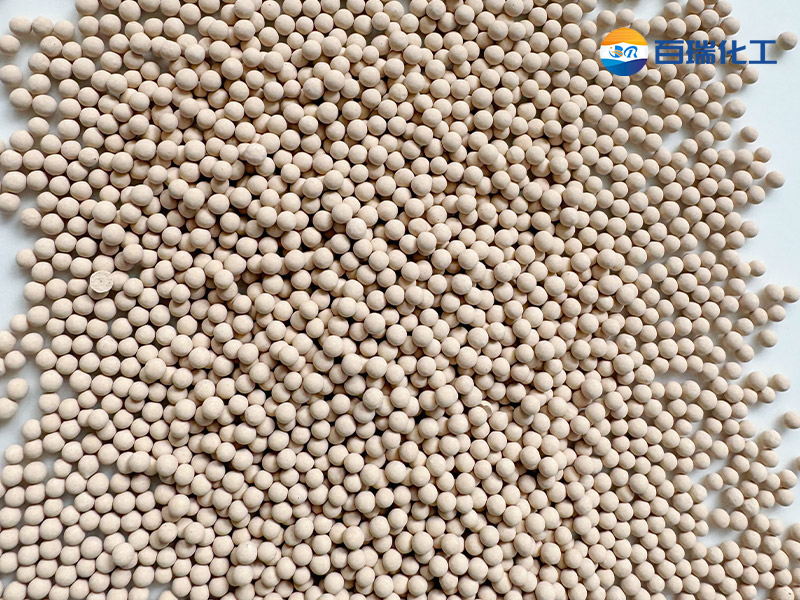
Uniform particle size ensures even airflow distribution within the filter bed, preventing channeling and maximizing the utilization of the entire filter media layer to improve purification efficiency.
How to Choose?
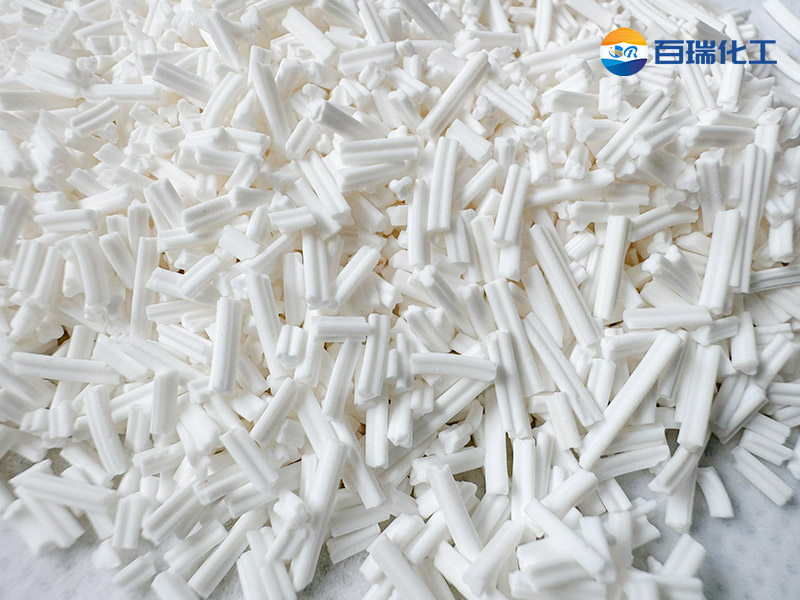
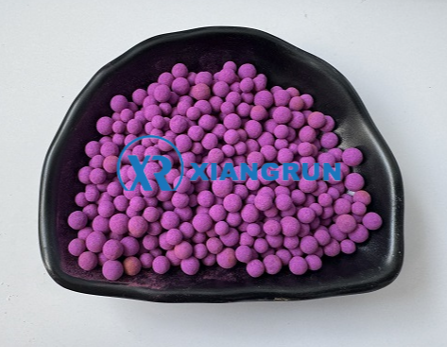
Zibo Xiangrun offers particle sizes of 2-3mm, 3-5mm, 4-6mm, and 5-7mm.
Specific Surface Area and Pore Structure Selection:
A large specific surface area provides numerous reaction sites, forming the basis for efficient adsorption and reaction. A suitable pore structure facilitates the rapid diffusion of pollutant molecules into the interior.
Moisture Content Selection:
Excessive moisture content can occupy active sites, affecting the contact between potassium permanganate and the target pollutant, leading to low initial efficiency.
How to Choose? Select products with low moisture content and ensure they are packaged in moisture-proof packaging.
FAQ:
Q1: What is the difference between potassium permanganate activated alumina and ordinary activated carbon?
A: Activated carbon mainly relies on physical adsorption, which is easily saturated and may desorb; while potassium permanganate activated alumina decomposes pollutants through chemical action, the reaction is irreversible, and more thorough, especially effective against small molecule gases such as ethylene and ozone.
Q2: What is its lifespan?
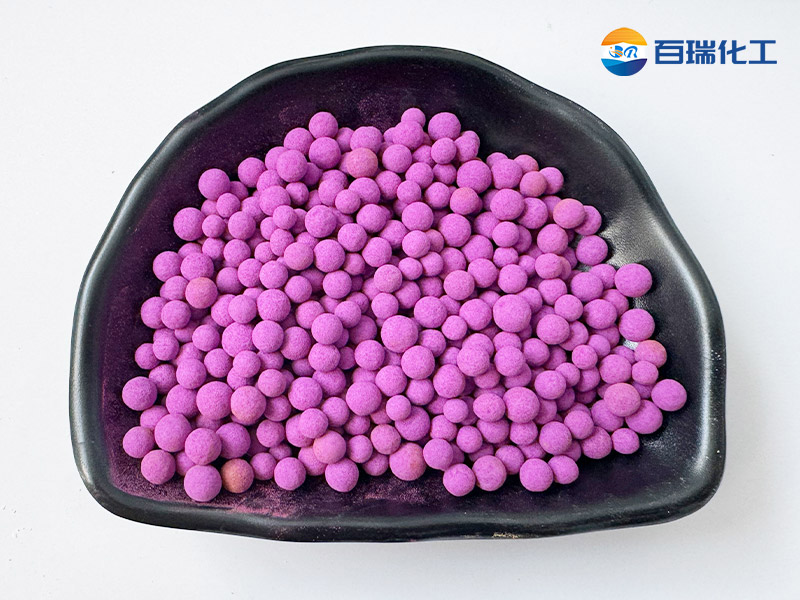
A: The lifespan depends on the concentration of pollutants, humidity, temperature, and the amount used. The most intuitive way to judge is to observe its color change. Zibo Xiangrun's potassium permanganate activated alumina has been tested and has a lifespan of approximately 5 years.